Función de Demandas · A conversation with Ricardo Riesco
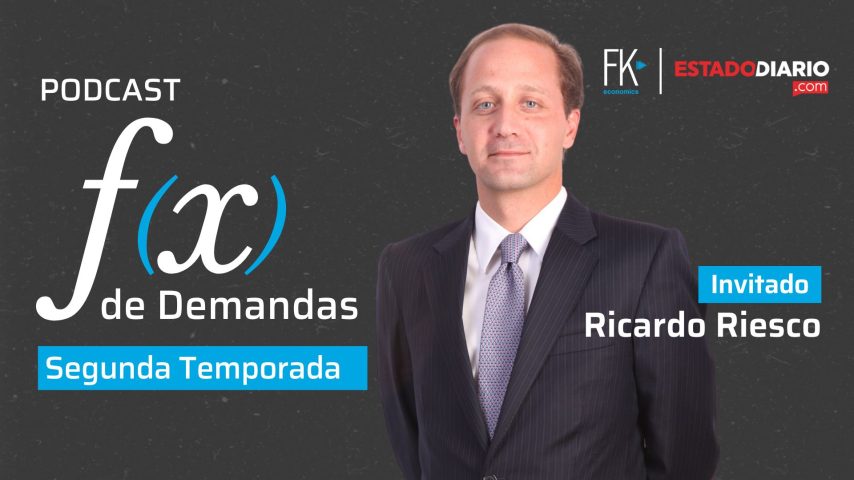
How does a competition agency bring economics into its work? In this episode, Jorge Fantuzzi talks with Ricardo Riesco, a lawyer and former National Economic Prosecutor of Chile, head of the agency responsible for enforcing competition law in the country. They discuss the symbiosis between lawyers and economists within the National Economic Prosecutor’s Office (FNE), how its teams are trained and recruited, the challenge of achieving consistent criteria, and the technical and political challenges competition agencies face today.
«We must be careful that public authorities do not intervene in markets without sufficient and reasonable economic data.»
You can listen to the full episode directly on Spotify, on Apple Podcasts, or in the player below:
Lawyers and economists: a symbiosis
Ricardo, we are very grateful to have you here. Welcome to Función de Demandas.
Thank you very much, Jorge, for the invitation, and also to FK Economics and Estado Diario. I’m at your disposal for a good conversation.
I’d love to focus the conversation on competition agencies. You have experience in Chile, but given your role you must also have come to know agencies in the rest of Latin America and in other countries. I’m interested in the intersection between the role of these agencies and economics. I wanted to start by asking how they bring economics in, how they train their staff, for example at the FNE.
Naturally, given four years of experience, my deepest knowledge concerns the FNE. But what I saw at the FNE I also saw, to a lesser extent, in other competition agencies around the world, including those in Latin America. Let me begin by saying that in the vast majority of jurisdictions we can speak of a symbiosis between law and economics. A symbiosis that, if you go back to the origins of competition law, did not exist: it has only been achieved over the last 50 years, since the late 1970s. It is stronger in the public sector than in the private sector, from what I see. And I also see a current, very interesting phenomenon in the more developed world of going back to the origins of competition law and stripping away its economic dimension.
That said, the symbiosis is so complete that, for example, when I left the FNE on December 11, 2022, of the staff working in the substantive areas, who numbered 82, 50 were lawyers and 32 were economists. Not a single case at the FNE lacked at least one economist on its team. And economists play a very important role in our country. As you know, the Competition Tribunal (TDLC), the specialized court that hears contentious competition cases, is permanently composed of three lawyers and two economists, currently Ricardo Paredes and María de la Luz Domper. And within the FNE we have many senior officials who are economists. For example, the head of the Anti-Monopoly Division, which handles all cases of unilateral anticompetitive conduct, is an economist, Gastón Palmucci.
One of the FNE’s aspirations is to have a chief economist at the institutional level, who can bring together the views of the different divisions and ensure greater consistency. Today, that consistency is pursued through bilateral conversations, but it always helps to have someone who unifies the economic view.
For those listening from abroad: in Chile, the National Economic Prosecutor must by law always be a lawyer. Hence what Ricardo mentions, about having a kind of chief economist at the institutional level to unify criteria. I also want to ask you about that consistency.
In fact, Jorge, economists in our competition system are on almost equal footing with lawyers. The only thing an economist cannot be is National Economic Prosecutor, as you pointed out. There is a legal reason for that: in Chile, only lawyers can appear on behalf of a party before a court, such as the Competition Tribunal or the Supreme Court. And the president of the Tribunal, that collegiate body made up of three lawyers and two economists, must always be a lawyer. But apart from that, economists are fully entitled to hold any position.
Training: the OECD and cooperation between agencies
I asked you at the beginning about training. About 30 of the 80 staff at the FNE are economists, but economics keeps advancing and I imagine there are more junior people, with less experience. How are they trained? Does the FNE offer any kind of formal training so that its staff stay up to date on the latest topics, on empirical issues or on particular industries?
That’s a very good question, because in law there is no compulsory course on competition law and, in economics, industrial organization is part, as I understand it, of a specialized or elective track, not of the core curriculum. So it is quite possible that both lawyers and economists, even if they are passionate about the field, know little about it when they start their careers at the institution. That makes training opportunities essential.
The basic training opportunities are more or less the same as those used by all Latin American institutions. I would say the main source of ongoing training is the OECD. Although it holds two major meetings a year, it also organizes meetings throughout the year that can be accessed via Zoom, on the widest range of legal and economic topics. And it has regional centers: about three years ago, I believe, the OECD’s regional center for Latin America opened in Peru, whose fundamental mission is to facilitate training. It can even be done through short modules that people can listen to at home on weekends, whenever they are interested.
But I would say the main training opportunity at the Latin American level comes from bilateral cooperation between competition agencies.
Is that at the case level? For example: I have a cartel case in a given market, you are starting a similar one, and that kind of exchange takes place.
Yes, it happens at the case level, both in cartels, naturally safeguarding all relevant confidentiality, and, a great deal, in mergers. Although in mergers, I would say, the main relationship is with the European Union, because that is usually where, in large cross-border mergers, the filing is made, and they are further along than we are. They have the most comprehensive, earliest view of the transaction.
But cooperation also takes place around market studies and institutions. For example, Paraguay is implementing and improving its leniency program, and we had many exchanges between our Anti-Cartel Division and the Paraguayan competition authority, CONACOM, on the essential elements of a good leniency program. We even trained judges in that country on what, based on the Chilean experience, the basic elements were for it to work. And in mergers we haven’t limited ourselves to discussing cases, after obtaining the relevant confidentiality waivers from the parties: we went twice to the Peruvian Congress in connection with the implementation of its merger control law. There is very fruitful cooperation among Latin American agencies; over these four years we had frequent training activities with Paraguay, Uruguay and other countries.
There is something very important the FNE has: an extremely close relationship with the United States Department of Justice, the DOJ. There is also a relationship with the Federal Trade Commission, but it is less close. The DOJ trains us, not only on cartels, and expects, not as an explicit request but certainly an implicit one, that we carry out that training mission with the other agencies in Latin America. It is a win-win: the United States can convey its view of what competition law looks like today, beyond specific cases, and we amplify that voice in the other countries of the region.
In addition to the bilateral channels, there are more local training opportunities, in which we also try to take part. But, to be honest, as a result of budget cuts at the FNE, more internal training has suffered tremendously: the annual budget for activities of this kind does not exceed CLP 10 to 15 million.
And in fact, some of these are open invitations. I remember some of them.
Some are open and others are more for FNE staff. Sometimes we took the opportunity to present a case we had doubts about, and these professors very kindly gave us their opinion.
Attracting and retaining talent
You mentioned consistency earlier, and I want to come back to it, along with another question: where does the agency get its economic talent from? An anecdotal, self-referential fact: in my class, three of us graduated with a specialization in industrial organization. One went into academia, another into business, and I went into competition. I’m talking about one of the two economics schools that existed in Chile at the time. So the first question is how you attract talent that can be trained in these subjects. And the second is consistency, because the number of FNE staff far exceeds the number of graduates in that specialization. And I say this in full transparency: you get different teams at the FNE. Sometimes you find that they are right in their concerns and other times you disagree more. How can the National Economic Prosecutor, being a lawyer, deal with the FNE not being uniform internally?
A very good question. As for recruitment, our main tool is the institution’s reputation: a reputation built on its independence and, above all, what interests economists, its technical nature. That is how we get people to want to work in a field of economics that apparently, and it would be worth studying why, is not very popular, even though competition cases in our country have triggered political, social and economic developments. That’s why it is essential for the FNE to maintain its prestige and technical nature, to attract economists who want to work on industrial organization.
Another thing that young people find very attractive is the quality and completeness of the data that can be obtained within an institution like the FNE. By law, it has tools to obtain, even compulsorily, all the information it requests from the parties for its analyses. That is an advantage private parties unfortunately don’t have. Before joining the FNE I worked in private practice, and the economists I worked with always complained about the absence, incompleteness or poor quality of the data companies gave them.
I complain about it. So I second the motion.
It is an endemic problem. The FNE insists and insists. That doesn’t mean we don’t need many economists to collect and clean that information, because companies don’t always have it in a form the institution can use for econometric analysis. But beyond the technical nature of the work, being able to see the full dimension of the problem with complete information attracts not only young people but also the professors we sometimes work with on market studies: you can see in their eyes how eager they are to access those databases, which naturally we cannot share for confidentiality reasons.
The other thing is to go out and look for the best students in the relevant courses, through these training opportunities, and offer them the chance to work on cases where they can contribute directly to improving people’s lives. That said, in the public sector in general, and this also benefits the FNE at the most junior levels, for recent graduates and, I would say, during the first five years of their careers, public sector salaries are comparable to those in the private sector. So if you can work on something you enjoy, with complete information, at a prestigious institution where you are also well paid, it is attractive. All FNE staff, economists and lawyers alike, are hired through a public competition, with technical tests, psychological tests and personal interviews with the division head, the deputy prosecutor and the prosecutor, which ensures we get talent.
That said, Jorge, we are like the youth academy of the private sector. We keep people for about three and a half years and then, to some extent, we lose them; sometimes we manage to win them back, which brings great joy to the institution. We lose them because, thanks to the experience they have gained, they go abroad to pursue a PhD in economics, with a certain preference for England and France, particularly the Toulouse School of Economics, or because they move to the private sector, to consultancies like yours, to capitalize on all the experience they have gained. I also see that as a win-win: if that exit route didn’t exist, the talent coming into the institution would probably be lower.
The challenge of consistent criteria
As for the consistency you raise, I understand the point, and that is why one of the FNE’s aspirations, which we were unable to fulfill for budgetary reasons, was to have a chief economist. That said, I’m not sure that complete uniformity in economic analysis is desirable, and even if it were, I’m not sure it is possible, given that the FNE, since the August 2016 reform, performs different functions. There is the prosecution of competition law infringements, where all the legal and economic analysis focuses on the past, on what has already happened, and there is merger review, which is forward-looking, about what will happen in the future. Some say we act as magicians or fortune tellers; we try precisely to support those projections.
But even within the same division, for example in mergers, you can get different teams. Sometimes you think, “This team understood the issue perfectly and asked me the right questions,” and other times you think they got lost in the analysis. I say it in full transparency, and it is natural, because they are different people. How do you ensure that certain standards of rigor prevail, perhaps through cross-checking? I don’t know the inner workings of the FNE.
There is a structure that encourages cross-checking within the FNE and within each division. That said, we split into teams because, as an institution, we don’t have the capacity to analyze all the notifications that come in, and because there are notifications that, from the very first minute, one believes may be more complex and go to phase 2, as opposed to others, some with no overlaps at all, that require far smaller teams. So, indeed, I grant you the point: some teams are better put together than others, all within a technical level…
Of course, we’re talking about a baseline that is already good.
Exactly. But not all the best people can work on all the good cases, because a phase 2 case, although people outside may not know it, is tremendously draining for the FNE. Not only because of the complexity of the analyses and of the counterparties’ legal and economic arguments, and they fight very hard, as you know, but also because of all the transparency work involved: making the file available to the public and analyzing in due depth the submissions of third parties who join the proceedings, whether to support a transaction or, more often, to oppose the merger or the remedies under consideration. Moreover, it is done in a very short time compared with other jurisdictions. So yes: greater consistency is desirable, it is an aspiration, but complete consistency in economic analysis across divisions is difficult, because some look backward and others look forward, as in mergers or in market studies when calculating the efficiencies arising from a regulatory change. But yes, there is room for improvement.
Technical challenges: the digital economy and data
To start wrapping up, what are, in your view, the main challenges facing agencies, the Chilean one or those in other countries, in terms of training and competition? I’m thinking, for example, of big data or data science, depending on how we understand the concept, of platforms, of new types of conduct such as interlocking directorates in Chile.
I would divide the challenges into two types. The first are more technical, and that is where I would place the ones you mention. We will have to pay more attention to digital economy markets, with particular emphasis on digital platforms. We will have to be able to identify, process and extract valuable information from big data. The FNE has already taken a first step, an insufficient one, but a step, with its Intelligence Unit, which is still housed in the Anti-Cartel Division but is meant to serve the whole institution.
To clarify: it is a team within the FNE, of data science experts, that provides support to the different divisions, particularly cartels.
Exactly. It started in cartels because we are talking about a unit made up, for the time being, of three people; those are the dimensions you have in the public sector. But given the evolution of digital markets and the new forms of infringement that may arise, that unit is meant to serve all areas of the FNE. There will probably be neither economists nor lawyers there, but pure engineers helping us and giving us the necessary input on public tenders, possible algorithmic collusion, and so on. That is a technical challenge that definitely exists.
The political challenge: a return to the origins
The other challenge is of a more political nature, I would say. I don’t want to bore you, but if you go back to the history of competition law, to the Sherman Act, competition law was a purely political and economic phenomenon. With the Industrial Revolution, markets begin to concentrate, which facilitates corruption, raises prices, excludes competitors, worsens workers’ conditions and, in addition, begins to influence the democratic process and political campaigns. “So let’s pass a competition law.” Until along comes a book that you have probably read and understood better than I have, “The Antitrust Paradox,” by Robert Bork, in the late 1970s, which says, “You have understood everything wrong.” Competition law is not a phenomenon with political implications, but a legal and economic one, because not all concentration is bad per se; sometimes it produces great efficiencies, and we must be guided by consumer welfare.
If you look at today’s global debate, led by the major powers, Europe and the United States, I sometimes notice a certain return to that more legal-political view of competition law, which treats the consumer welfare standard and economic analysis as an overly economistic view of markets that allegedly led to weak enforcement and to market concentration.
What has been pejoratively called “hipster antitrust.”
Yes, and it has its valid points. Nothing here is black and white. We are talking about a discipline that is, at most, 132 years old, so there is much to discover, revisit and correct. But what we must be careful about is that public authorities do not intervene in markets without sufficient and reasonable economic data, which is what economics provides, showing that the consequences of their actions will produce an improvement and not a deterioration for the end consumer, in price, quality or innovation. It is a delicate balance. These are understandable criticisms, but we must be very careful about how they are applied. That is why I believe competition law must be in the hands of technical bodies that are independent from other branches of government.
And, in the Chilean case, bound by what the law mandates.
Exactly, by the principle of legality. Our system, to be honest, makes the effective and timely enforcement of competition policy somewhat difficult, but what cannot be denied is that it fully and absolutely guarantees due process: when the FNE sees infringements, it brings a case before an independent court, and those decisions are reviewed by the Supreme Court. And there is another temptation to guard against, which we saw in Chile: asking competition law to do things that go beyond what it really is. You’ll remember the acquisition of CGE by State Grid, the Chinese state-owned company, which indeed concentrates in its hands a large part of the country’s electricity distribution assets. Congress was very insistently calling on us to prohibit that transaction on grounds of…
…national security, of politics.
Exactly, strategic considerations. And we said: we are not political scientists. We can understand what you are raising; nobody likes to depend on China, or the United States, or any other country, because that allows power to be exercised in various ways. But the FNE is not the body called upon to prohibit such transactions or to issue pronouncements beyond its remit, as is being done in Australia or being revisited in the United States and Europe. We do what the law mandates, which is the foundation of the rule of law; colloquially, “cobbler, stick to your last.”
Exactly. Ricardo, I want to thank you for this very valuable and interesting conversation, for the inside view of the agency for those of us on the outside. Many people listen to us from other countries and jurisdictions, and I think they will find the economics-related experience of someone who led a competition agency very interesting.
Thank you very much, Jorge, FK Economics and Estado Diario. I hope we can do it again sometime.