Función de Demandas · A conversation with Álvaro Bustos
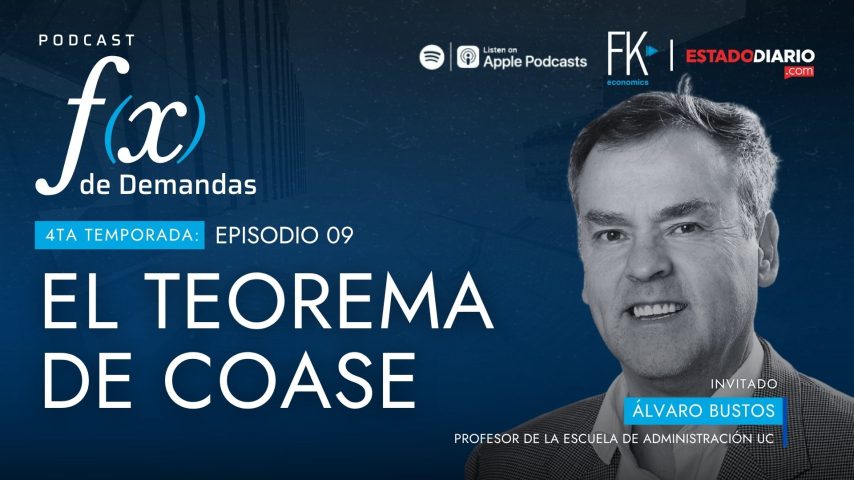
Few ideas lie as close to the heart of the intersection between economics and law as the so-called Coase theorem. In this episode, Jorge Fantuzzi talks with Álvaro Bustos, an engineer with a master’s in Economics, a master’s in Legal Studies and a PhD in Economics, director of the School of Business Administration at Pontificia Universidad Católica de Chile, who has devoted more than two decades to law and economics. They discuss who Ronald Coase was, externalities, the famous example of the rancher and the farmer, and why transaction costs and the allocation of rights remain so relevant for regulation.
«People misunderstand Coase when they say that regulation doesn’t matter. It is quite the opposite.»
Spotify:
Apple Podcast:
WHO RONALD COASE WAS
Álvaro, thank you very much for joining us.
Jorge, the pleasure is all mine; it is a real honor to be here. As I mentioned earlier, law and economics has been my professional life. It is what I have devoted the last 20 or 25 years to, as a professor in the United States and as a researcher here in Chile, and we have a Latin American alliance to make the field more popular and better known. So I’m delighted to talk about something as important as the Coase theorem.
Before we get to the “theorem,” can we start with a note on who Coase was? I know our audience is familiar with him, but he is an interesting figure, and understanding his biography helps understand his contribution.
Absolutely. Coase is an icon, an idol, if I may say so, in our niche. Many consider him the father of modern law and economics. If you look it up, five big names probably come up: alongside Coase there is Guido Calabresi, who contributed everything related to accidents; Richard Posner, the father, not Eric; both served as judges. Among applied economists there is Gary Becker and, on the institutional side, James Buchanan. But Coase is in a category of his own.
Coase was an old-school English economist. The final part of his career, for which he is best known, was spent as a professor at the University of Chicago, at the Law School: an economist working in a law school. His training was mainly in economics. He lived a long life, more than a hundred years, and won the Nobel Prize in Economics in 1991.
He won it essentially for two major contributions. One is what we are going to talk about today. The other, also very important, dates from 1937: “The Nature of the Firm,” everything to do with transaction costs. Today we will talk about the other paper, from 1960. It is a real honor to be able to talk about him.
So that his other contribution isn’t left hanging: I know it’s not today’s topic, but that framework is also closely related to how we understand economics today, to seeing firms as organizations that ultimately simplify processes. Essentially, they are a way of organizing.
Absolutely, the firm is an organization. In fact, the big question he had, as he tells it in that paper, written when he was 27, imagine, a genius, was: if markets are so efficient, why do we need firms? And he arrives at the concept of transaction costs. Firms make it possible to reduce transaction costs, the cost of having to interact with so many different people in the economy. The economy can work very well as an allocator of resources, through prices and so on, but the firm also plays a role in lowering those costs. There is a trade-off there, which underlies the theories of integration, and as you say, it is very important for defining a company’s organizational structure. And that was in 1937, imagine.
And the Nobel came in 1991. We are talking about a whole lifetime between one and the other.
Indeed.
A “THEOREM” THAT ISN’T A THEOREM
Let’s talk about the 1960 paper. Can we tell the story of how the so-called Coase theorem came about? Because the story goes that he himself said it wasn’t a theorem.
I don’t know all the details; you may know more than I do. But indeed, when he wrote the 1960 paper, “The Problem of Social Cost,” he wrote it as a great, brilliant reflection. It is a long paper, more than 40 pages, and it contains no theorem stated and proven, with a proposition and so on.
It was later contributors who formalized it. The story is that George Stigler, also a Nobel laureate, formalized the theorem, although there are different accounts of whether the proof came before or after. But, and this is the important thing for our audience, the seed, the root, the intuition are all in that paper, “The Problem of Social Cost.” That is what we want to convey here.
In fact, that paper and his discussions with his colleagues at the University of Chicago at the time, including Stigler, when he was putting this forward as an idea…
…a revolutionary one. His great counterpart was Arthur Pigou, another British economist. It is remarkable how Coase put forward a way of reasoning that went completely against the grain of the thinking at the time. And the surprising thing, which we can perhaps leave for the end, is that we still see that outdated logic today, the one Pigou suggested. I think Coase is extremely relevant today, and at the end I’ll mention where I think we could apply him in Chile. I think there is plenty of room to apply Coase.
EXTERNALITIES: THE STARTING POINT
Let’s get to that, because I’m very interested in bringing it down to concrete examples, and not only in Chile. But first let’s explain the idea. There is a preliminary concept you introduced in connection with Pigou: the problem of externalities. Can we start by explaining what externalities are, how they used to be addressed, and what Coase’s contribution was?
Sure. An externality is a very important concept, not only for economists and lawyers, but for human beings in general. Essentially, externalities are effects that are not internalized in the prices of goods and services. Positive or negative effects that are not reflected in the valuation of those goods and services.
There are countless examples. When you take a bus, you pay a fare to go from point A to point B. But, whether or not we realize it, classically, although some countries do include it, that price does not include the fact that the trip will generate pollution. There is always smoke, noise, nuisance: negative effects that go beyond the transport from A to B. Now, externalities can be positive as well as negative. Vaccines, for example, or having a nice-looking house: I don’t do it for others, but others benefit.
Let’s explain positive and negative externalities with an example. For a positive externality, the vaccine is the textbook case. Why? Because I get vaccinated and enjoy the private benefit of not getting sick, but there is also a public benefit: by not getting sick, I stop infecting others.
Absolutely. And if we turn to negative externalities, there are productive activities, such as producing energy or coal, which is heavily restricted today, that inevitably have polluting effects, on the air, on water or in other ways, affecting, for example, fishermen or the quality of life of people living in nearby towns.
And that is not part of the cost borne by the producer, the way its raw materials are.
Exactly. There is a private effect, a private cost and benefit, but also a social effect, a social cost and benefit. Hence the title of Coase’s paper: “The Problem of Social Cost.” Right in the introduction he says: that is what interests me.
And the point of these examples, the vaccine or cigarettes, which are another example of a negative externality: I smoke, I bear a cost, which is what I pay for the cigarette, but the smoke bothers others, and that is a cost I don’t pay.
And in that same example, Jorge, you place a burden on the health system because more people get sick, which also harms the rest of the social security system. There is a far from trivial ripple effect.
The beauty of these examples is that they show very clearly how externalities are generally addressed. With vaccines, there are many I don’t pay for. The COVID vaccine is perhaps the one most present in everyone’s mind: the State gave it to me, so to speak, because of its large positive externality. With cigarettes, a tax is imposed that essentially tries to compensate for the harm my private consumption causes to others.
Absolutely. In the first case we are typically talking about subsidies: there is a positive benefit and I don’t pay, or I pay much less. One could think of education and a range of other things that, as a society, we would like more people to have, because they are acquired privately but benefit society. And the other, which you rightly mentioned, is a tax to make transactions internalize the fact that there is not only a private effect but also a social one, in this case a cost.
COASE’S PROPOSAL
And here comes the break, what Coase is going to propose. The standard approach of these taxes and subsidies is Pigou’s logic. That’s why I said Coase came along and revolutionized everything.
Can you describe that new paradigm?
One of the things that, as we discussed off camera, sometimes puts people off Coase is that the formulation of the theorem is convoluted. It is not easy to grasp at first, so you shouldn’t stop at the words but go to the example he himself gave.
He said: let’s start from the existence of negative externalities, what we have just discussed. To simplify, there is a person A engaged in one economic activity and another person B engaged in another. They could be neighbors: one is a producer that makes noise and generates odors, and the other has a different kind of activity, say a fishery. Activity A and activity B, and a negative externality arises between them. In addition, we have to consider that this externality could be corrected by either of them. Whoever is engaged in activity A could do something to prevent it, and whoever is engaged in activity B could do something to avoid suffering it.
In legal terms, and thinking of an audience of lawyers, we are essentially talking about rights. There may be a regime in which whoever engages in activity A has the right to generate the externality, however strong that sounds, or, alternatively, one in which B has the right not to suffer it.
With all that in context, the Coase theorem essentially says the following: in the presence of externalities, if rights, to generate the externality or not to suffer it, are clearly assigned, and in addition transaction costs, in the most extreme formulation, are zero, meaning that the parties can bargain without any difficulty, it doesn’t matter whether I assign the rights to whoever generates the externality or to whoever suffers it: the parties will reach an efficient allocation of resources.
Let me clarify, because “efficient allocation of resources” sounds very abstract, although it is the most accurate way of putting it; I’m speaking as an academic. Why? Because what intuitively comes to mind is: “What we want is to eliminate the externality.” Well, depending on all these variables, how much activity A is worth, how much activity B is worth, how large the externality is and what solutions are available, which are the elements in play, there will be cases where the externality is eliminated, through corrective action by A or by B. But there may be situations, and this is very interesting, in which the socially optimal outcome is for the externality to continue to exist.
Before you give the concrete example, part of the elegance of that formulation is that it is decentralized. In Pigou’s case, with taxes and subsidies, I have to determine how large the externality is and try to set a tax. Coase says: if rights are well assigned and transaction costs are zero, let the parties reach an agreement, because they will arrive at the best outcome.
It is a beautiful proposal, which basically relies on the functioning of markets, on the idea that different people, organizations and agents, if we are rational, will solve these problems among themselves. We’ll come to the limitations later, because the theorem rests on assumptions.
THE RANCHER AND THE FARMER
Let’s take the example Coase himself gives, which Cooter and Ulen use in their famous textbook, used to teach law and economics all over the world. Curiously, he devotes very little space to it in the paper: fewer than 10 of its 40 pages. It is the interaction between a rancher, someone who keeps cattle, and an adjoining neighbor, a farmer who grows corn, for example.
“Choclo,” as we call it in Chile.
Or corn, or tomatoes, whatever you like. It is easy to imagine that, if no one addresses the problem, the rancher will let his cattle graze wherever they want. Cows, as free creatures, don’t recognize boundaries, and eventually they could trample and destroy part or all of the farmer’s crop. That is the externality: activity A is beef production and activity B is the crop. And to complete the setup: there is always the possibility that the rancher fences in his cattle, or that the farmer protects his crops. That is the initial scenario.
Where does the legal and institutional side come in? There will be rights. Let’s go to the two extremes: either the rancher has the right to let his cattle graze wherever they want, or the farmer has the right not to suffer this externality; that is, if he suffers damage, he must be compensated.
Then the parties rationally decide how to adjust to that context. The regulatory and institutional framework shapes what the parties do, but ultimately, as you said, it is the parties who decide; it is not a regulator imposing what must be done. The parties are rational, and that is the shortsightedness of some regulators, and sometimes of judges: not realizing that when something is imposed, the parties adjust to it. Coase realizes that what ultimately matters is how the parties behave.
Let’s add one last element: the cheapest way to eliminate the externality is to fence in the cattle. Suppose that the destruction of the crop causes the farmer a loss of 2 million, in whatever unit you like, and that putting up the fence costs only 1 million. So we want the cattle fenced in. What happens if the rights belong to the farmer? The rancher immediately understands that if he lets his cattle roam free, he will have to pay 2 under the legal regime. It is more efficient to fence in the cattle: it costs him 1 and saves him another 1. That would have been, in a way, the traditional approach: there is no tax, but a decision that eliminates the harm is induced.
And here comes the beauty of Coase. Let’s now imagine that the rights belong to the rancher. You would think, “The poor farmer is done for; he’ll have to accept the cows coming in and destroying his crop.” However, Coase says: if the parties are rational, the farmer should approach the rancher and say, “I know you have the right to let your cows go wherever they want, but I’ll offer to pay you what it costs to fence them in, and even a bit more.” Because there is a whole range between 1 and 2 in which both end up better off. If I pay you 1.1, you don’t destroy 2 of my crop; I pay for the fence and you also make 0.1. At the limit, I pay you exactly 1; if you are rational, you’ll accept. And we avoid the problem. That is a solution that comes from a negotiation in which the initial allocation of rights no longer mattered, because the parties were able to bargain.
Rights are key, but what is not key is who holds them.
And that is where the confusion arises. Coase’s strict formulation is that, if these two assumptions hold, well-assigned rights and zero transaction costs, it makes no difference to whom the rights are assigned. The mistaken conclusion people tend to draw is: “So rights don’t matter at all.” They do matter, a great deal. In reality there are transaction costs, and property rights are often not well assigned. So who holds the initial rights will matter a great deal for the final outcome and for what the most efficient solution is in a reality that is no longer perfect, that is not frictionless.
I want to ask you about the assumptions, but first a footnote to your example. These are two productive units: the farmer and the rancher both produce. There is another example I really like: I plant a tree in my yard that blocks my neighbor’s view. Neither of us is productive. If I have the right to plant the tree and it bothers my neighbor, he should be willing to pay me a certain amount to remove it, and there will be a negotiation up to the efficient point. And the same the other way around: if he has the right to keep his view unobstructed and I value the tree, I should be willing to offer him something.
Absolutely, and we will reach the same result. That is what you are showing, and we are only getting started: the reach and implications of the theorem are immense. Add noise to the mix. I sometimes hate noise, and I have noisy neighbors who throw parties: there’s another negative externality, not productive at all, as you say. And you ask yourself whose right it is: the right to peace and quiet? We have decibel rules, but one could simply reach an agreement with the neighbor. How much do you value throwing your party? I could compensate you, or vice versa.
That is also a very good example of poorly assigned rights. One says, “I have a right to my silence,” and the other says, “I have a right to throw a party in my own home.”
Exactly.
WHEN TRANSACTION COSTS ARE NOT ZERO
I want to take you to the other assumption, transaction costs, which is extremely interesting and even reaches the level of public policy and theories of justice. Liberals and libertarians often use the theorem to say, “We don’t need such a large role for the State; the market works on its own, don’t intervene.” I once heard Deirdre McCloskey, a staunch liberal, say, “Careful: the theorem should not be read as ‘if property rights are well assigned and transaction costs are zero, we reach an efficient solution.’ It should be read in the negative: since transaction costs are rarely zero, the role of the State is very important.”
Absolutely, and there is no contradiction. That is precisely why I keep repeating that people misunderstand Coase when they say that regulation, rights or institutions don’t matter. Quite the opposite. They wouldn’t matter if we lived in an ideal world, as you mentioned, with no transaction costs and well-assigned property rights. But in reality we have both: transaction costs and weak rights. And in those contexts we need our regulators to do a “buena pega.”
For those listening from other countries: “buena pega” is Chilean for a good job.
Sorry, you’re absolutely right. That they create the right incentives. Suppose we go back to the rancher and the farmer, but now they can’t talk to each other: they hate each other, they have no way of communicating. If you know in advance what the most efficient solution is, who should fence or protect, which is cheaper, you assign the kind of right that induces the party for whom it is cheaper to do it.
And to show how rich the concept is, you find it in situations far removed from production. Think of a highway to the coast with cars on it, and a side entrance where other cars are merging. There is a question of rights: who has priority? If we took Coase’s suggestion literally, we’d say he’s crazy: how are they going to negotiate? Do they look each other in the eye at 120 kilometers per hour, call each other on the phone? It’s impossible to reach an agreement. There is a point at which transaction costs are prohibitive, and that is where I need a clear rule that determines in advance what is most efficient: obviously, that whoever is on the highway has priority and the other yields. That is also Coase.
Let me continue along those lines with smokers.
Go ahead.
The hospital example. Smoking used to be very common, and one might think: I arrive at the hospital, I smoke, the other person doesn’t want me to smoke; let’s reach an agreement or come to blows. But many people are in the hospital because they are sick, and those people are not in a position to defend their rights. So a one-way ban on whoever generates the externality makes sense, because negotiation is not possible. And the nice thing is that you can see again why this was so revolutionary. A few years ago, in Chile, a plant heavily polluted some towns…
Quintero, the case you’re referring to.
Exactly. One might say: if transaction costs were zero, it would be enough for this plant to pay all the neighbors for its right to pollute, and the problem would be solved. But there were so many neighbors, and the effect of the pollution was so poorly understood, that the transaction cost was, once again, prohibitive. So what is the right approach? To go back to Pigou: tax pollution or emissions, or simply ban a certain range of emissions, because free bargaining cannot take place in a situation like that.
PERMIT MARKETS AND COASE TODAY
You’re right, but I wouldn’t be so categorical, because I think you have to analyze it case by case. I fully agree with you that there are situations, such as climate change or data management, which is where I was heading, where Coase is present. Think of information privacy rights: people say each person should sell their own data, but that would be an almost impossible market because it is, as you were saying, highly fragmented. The beauty is in the counterexample, which takes us to property rights. There are examples, especially in the United States and New Zealand, of markets that have been created to trade permits under pollution caps, and they work. The concept is the same: reduce transaction costs so that the solution can emerge.
The classic example is acid rain and sulfur dioxide, pollutants we don’t want. All the companies in the market that generated these undesirable effects were given a limit on how much they could emit, in units such as tons. And the beauty is that a market for permits emerged. Efficient companies, capable of reducing their emissions, compared how much the technology cost them with the price of the permit. If they could cut emissions at a lower cost than the permit, they sold the surplus. That generated supply and demand for permits: supply came from the most efficient companies and from those leaving the market, which no longer needed permits; demand came from new entrants and from the inefficient ones, which needed to buy more because they polluted more. And that is how you reach the efficient solution. These are wonderful examples showing that it does work.
That’s why, regarding what you were telling me, a classic case of externality, with a bad guy and a good guy, I wouldn’t rule out in advance structures that could be somewhat more efficient. Obviously not one-to-one negotiations, but imagine a negotiation between the company and an association representing those affected, or with the municipality, some centralized party that allows coordination and then an efficient distribution. Now, there is a contrast: it is no coincidence that this logic of permits and assigned rights works well in developed countries, because it requires an apparatus that measures with great precision how much you are polluting. In other countries this is almost nonexistent.
We’ve run out of time. There are endless cases, and the conversation shows how relevant the theorem, the man and his contribution are.
Let me say one last thing, Jorge. It is true that the theorem is designed for an ideal world: rational people, no transaction costs, no asymmetries of bargaining power, and reality is very different. But even so, it tells you where to focus in order to adjust regulations and achieve a somewhat more efficient allocation. Where is Coase still very relevant? In data management, as I was saying: there are externalities there, people are afraid of having their identity stolen or their privacy violated, but data is needed for artificial intelligence, and Google, Amazon and everyone else thrive on it. A market would be needed, and that logic is Coase’s; I’m not offering a solution, but it is pure Coase.
And the Chilean case, which I think applies to Latin America and anywhere else, is that of investment permits. There, the approach is: there is an externality, the company complies with the limits, and that’s it. I think there is room to introduce some negotiation there, and we would have a much more efficient system. With that, I’ll stop.
As I said, once you start thinking about it, there are examples in telecommunications, which is actually what led Coase to think about this, in fisheries in Chile… The number of applications is enormous, and that’s why the conversation was so enjoyable. Álvaro, thank you very much for sharing your thoughts on Coase and his theorem, or non-theorem, and on solving the problems of social cost.
Thank you for having me, Jorge.